
Table of Contents
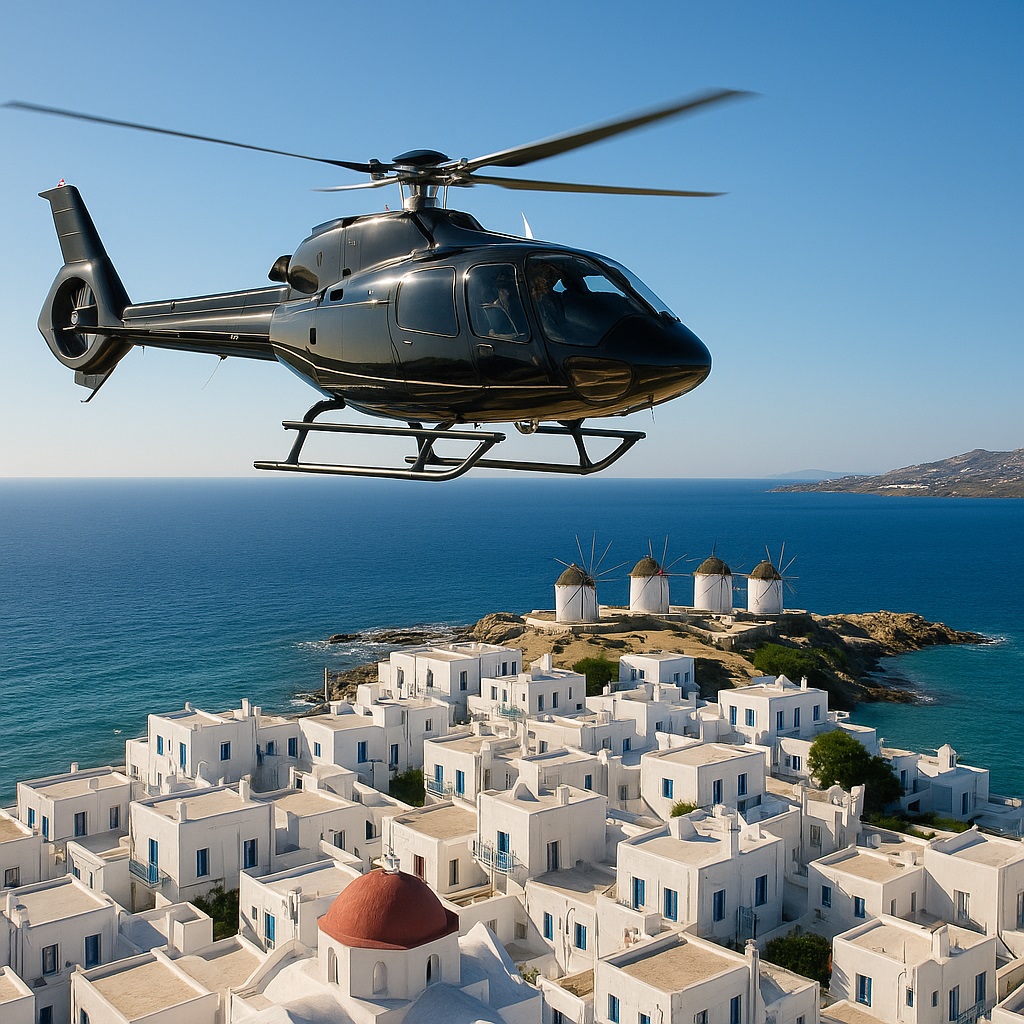
Picture this: you’re sitting in Athens traffic, watching precious vacation time tick away, when you could be soaring above the Aegean Sea in just 40 minutes. That’s exactly what happened to me last summer, and honestly? It changed everything about how I think about Greek island hopping. Helicopter Mykonos transfers aren’t just about getting from point A to point B anymore — they’re about transforming your entire travel experience into something genuinely unforgettable. When you choose a helicopter Mykonos service, you’re not just booking transportation; you’re investing in memories that’ll make your Instagram followers question their life choices.
Look, I get it. The ferry seems practical, flights feel “normal,” but here’s the thing — sometimes you need to treat yourself like the royalty you are inside. And trust me, there’s absolutely nothing quite like watching the Greek islands unfold beneath you while sipping champagne at 1,000 feet.
Why Choose Helicopter Transfer Over Traditional Methods?
Let’s be real about this for a second. The ferry from Piraeus to Mykonos? You’re looking at 2.5 to 5 hours depending on which one you catch. That’s almost half your day gone, and honestly, Greek ferries can be… well, let’s just say they’re an experience in themselves (and not always the good kind).
Commercial flights aren’t much better when you factor in airport security, delays, and that awkward 30-minute flight that somehow takes 4 hours door-to-door. I mean, who has time for that nonsense?
But helicopter transfers? Forty minutes of pure luxury. You literally go from central Athens to Mykonos in less time than it takes to watch a Netflix episode. The math just makes sense, especially when you consider what your time is actually worth.
Here’s what really gets me excited though — it’s not just about speed. You get unparalleled views of the Cyclades archipelago that simply don’t exist from a ferry deck or airplane window. We’re talking about seeing Kea, Kythnos, and Syros from a perspective that 99% of travelers never experience.
The Magna Aviation Difference: Premium Service Standards
When I first researched helicopter services in Greece, Magna Aviation kept popping up, and there’s definitely a reason for that. They’ve been operating since 2006, which in the helicopter charter world means they’ve survived economic crashes, pandemic closures, and every challenge you can imagine.
What sets them apart isn’t just their fleet (though their helicopters are absolutely pristine). It’s their approach to customer service. These folks understand that when someone books a helicopter transfer, they’re not just buying a ride — they’re buying an experience.
Their pilots aren’t just qualified; they’re storytellers. During my flight, Captain Andreas pointed out ancient shipwrecks, explained the geological formations we were passing, and even adjusted our route slightly to catch better views of some smaller islands. You simply can’t get that level of personal attention on a commercial flight.
Safety standards are non-negotiable with Magna Aviation. All aircraft undergo rigorous maintenance schedules, and their pilots log significantly more hours than minimum requirements. When you’re trusting someone with your life at 1,000 feet, these details matter enormously.
What to Expect During Your Aerial Journey
The experience starts the moment you arrive at the helipad. Forget about long security lines or crowded waiting areas — you’re typically greeted personally by your pilot and given a brief safety orientation.
Pre-flight preparation takes maybe 10 minutes. You’ll get basic safety instructions (which are actually pretty interesting), learn about your specific aircraft, and have any questions answered. The staff genuinely wants you to feel comfortable and excited, not nervous.
Once airborne, the real magic happens. The first few minutes, you’re still over Athens, seeing the Acropolis and Parthenon from angles that tourists pay hundreds of euros to glimpse from observation decks. But then you hit the coastline, and suddenly you’re flying over water so blue it looks fake.
The Aegean Sea from helicopter altitude is absolutely breathtaking. You can actually see through the water to the sea floor in many areas, and the color variations are mind-blowing. I’ve traveled extensively, but this perspective was completely unique.
Island hopping by air gives you context that’s impossible to get otherwise. You see how these islands relate to each other geographically, understand why ancient Greeks chose specific locations for settlements, and appreciate the sheer scale of the archipelago.
Scenic Highlights and Photo Opportunities
Let me tell you about the views, because words honestly don’t do them justice. About 15 minutes into the flight, you’ll pass over Kea Island — and if you’re lucky with weather conditions, you can see all the way to its famous ancient lion sculpture carved into the hillside.
Kythnos appears next, with its dramatic coastline and traditional Cycladic architecture visible even from altitude. The contrast between the stark white buildings and deep blue sea creates these incredible photographic opportunities that simply don’t exist anywhere else.
But here’s where it gets really special: approaching Mykonos from the air. You see the famous windmills first, those iconic white structures that appear on every postcard. Then Little Venice comes into view, with its colorful houses literally built into the sea.
The helicopter landing in Mykonos is an experience itself. Most services use a dedicated helipad near the town center, so you’re not dealing with remote airports or lengthy ground transfers. You land, grab your luggage, and you’re literally minutes away from your hotel or the beach.
Photography enthusiasts should bring extra battery packs and memory cards. The lighting conditions over the Aegean create these golden hour effects that last much longer than you’d expect, especially during summer months.
Booking Your Helicopter Experience: Practical Considerations
Pricing varies significantly based on several factors. Peak season (July-August) commands premium rates, while shoulder seasons offer better value without sacrificing the experience quality. Group sizes also impact per-person costs — splitting a helicopter among 4-6 passengers makes it surprisingly reasonable.
Most operators require advance booking, especially during high season. I’d recommend reserving at least 2-3 weeks ahead for summer travel. Weather can impact flights, so having flexible dates helps enormously.
Weight restrictions are real but reasonable. Standard limits accommodate normal luggage plus personal items. If you’re bringing extensive camera equipment or oversized bags, mention this when booking.
Payment policies vary, but most reputable companies require deposits with balance due before flight departure. Credit cards are generally accepted, though some offer discounts for bank transfers or cash payments.
Weather Conditions and Best Flying Times
Greek weather is generally helicopter-friendly, but conditions do matter. Strong winds (common in the Cyclades) can impact flight schedules, especially during spring and fall months.
Morning flights typically offer the calmest conditions and clearest visibility. If you’re flexible with timing, early departures also provide better photographic lighting and fewer air traffic delays.
Summer months (June through September) offer the most reliable weather windows, though they’re also the most expensive. Spring and fall can be absolutely gorgeous for flying, with fewer crowds and often spectacular atmospheric conditions.
Winter helicopter travel is possible but weather-dependent. The Aegean can be rough during winter storms, and visibility may be limited. Most operators reduce schedules during these months.
Safety Standards and Regulations
European Aviation Safety Agency (EASA) regulations govern all commercial helicopter operations in Greece, and standards are genuinely rigorous. All pilots must maintain current certifications and log specific flight hours annually.
Aircraft maintenance follows strict protocols, with inspections required after specific flight hours or time intervals, whichever comes first. These aren’t suggestions — they’re legal requirements with serious penalties for non-compliance.
Weather minimums exist for good reason. Pilots can’t legally fly in conditions below specific visibility or wind speed thresholds. While this occasionally causes delays, it demonstrates professional commitment to passenger safety.
Insurance coverage should be comprehensive for any reputable operator. This includes both aircraft insurance and passenger liability coverage. Don’t hesitate to ask about coverage details when booking.
Maximizing Your Helicopter Experience
Seating selection matters more than you might think. Window seats obviously provide better views and photo opportunities. If you’re traveling as a couple, request seats on the same side for shared viewing experiences.
Camera equipment should be lightweight and easy to handle. Smartphones actually work brilliantly for helicopter photography, often better than heavy DSLR cameras in cramped cabin spaces.
Dress appropriately for the experience. While helicopters are climate-controlled, landing areas can be windy. Secure hats and sunglasses, and avoid loose clothing that might blow around.
Communication with your pilot enhances the experience dramatically. Most are genuinely passionate about aviation and the Greek islands. Ask questions, request specific viewing angles, and don’t be shy about photo opportunities.
Alternative Routes and Extended Tours
Beyond simple Athens-to-Mykonos transfers, many operators offer extended touring options. Multi-island tours can include Santorini, Paros, or Naxos, creating comprehensive aerial sightseeing experiences.
Sunset flights are absolutely magical, though they require careful timing coordination. The golden hour lighting over the Cyclades creates photography opportunities that are simply unmatched.
Custom itineraries are often available for special occasions. Wedding proposals, anniversaries, or milestone celebrations can be enhanced with personalized routing and timing.
One-way versus round-trip bookings offer different advantages. One-way provides maximum flexibility for your island stay, while round-trip often includes pricing advantages.
Comparing Costs: Value Analysis
Let’s talk money, because I know that’s what you’re really wondering about. Helicopter transfers definitely cost more upfront than ferries or flights. But when you factor in time saved, unique experiences gained, and pure convenience, the value proposition becomes much clearer.
Consider this: a fast ferry ticket runs around €45-60 per person, but takes 2.5-4 hours each way. That’s essentially a full day of your vacation spent in transit. Helicopter transfer costs significantly more per person but saves 6-7 hours of travel time round-trip.
For special occasions — honeymoons, milestone birthdays, or once-in-a-lifetime trips — the cost difference often becomes irrelevant compared to the memory creation potential.
Group bookings make helicopter travel surprisingly accessible. Split among 4-6 people, per-person costs become much more reasonable, especially when you consider the time savings and unique experience.
Key Takeaways
- Helicopter Mykonos transfers reduce Athens-to-Mykonos travel time from 4+ hours to just 40 minutes
- Magna Aviation offers premium service standards with experienced pilots and well-maintained aircraft
- Scenic views include aerial perspectives of multiple Cycladic islands and crystal-clear Aegean waters
- Best booking practices include advance reservations (2-3 weeks) and flexible date options for weather contingencies
- Morning flights typically provide optimal weather conditions and superior photographic lighting
- Safety standards meet rigorous European Aviation Safety Agency requirements with comprehensive insurance coverage
- Cost considerations become more reasonable when factoring time savings and shared group bookings
- Photography opportunities are unparalleled, with unique aerial perspectives unavailable through other transportation methods
- Weather flexibility is essential, as wind conditions can impact flight schedules in the Cyclades region
- Premium experience includes personalized service, expert pilot commentary, and convenient landing locations
Honestly? If you can swing it financially, helicopter transfer to Mykonos isn’t just transportation — it’s the perfect way to kick off an unforgettable Greek island adventure. The memories you’ll create during those 40 minutes will last much longer than the extra cost sting, and isn’t that what great travel experiences are really about?